Case study
Encore Recommendation Prototype
An internship prototype that transformed purchase records through a Python and SQL analysis pipeline into recommendation results, a working dashboard, and an executive presentation.
- Role
- Data analyst intern and prototype developer
- Status
- Completed internship prototype with private evidence
- Year
- 2024
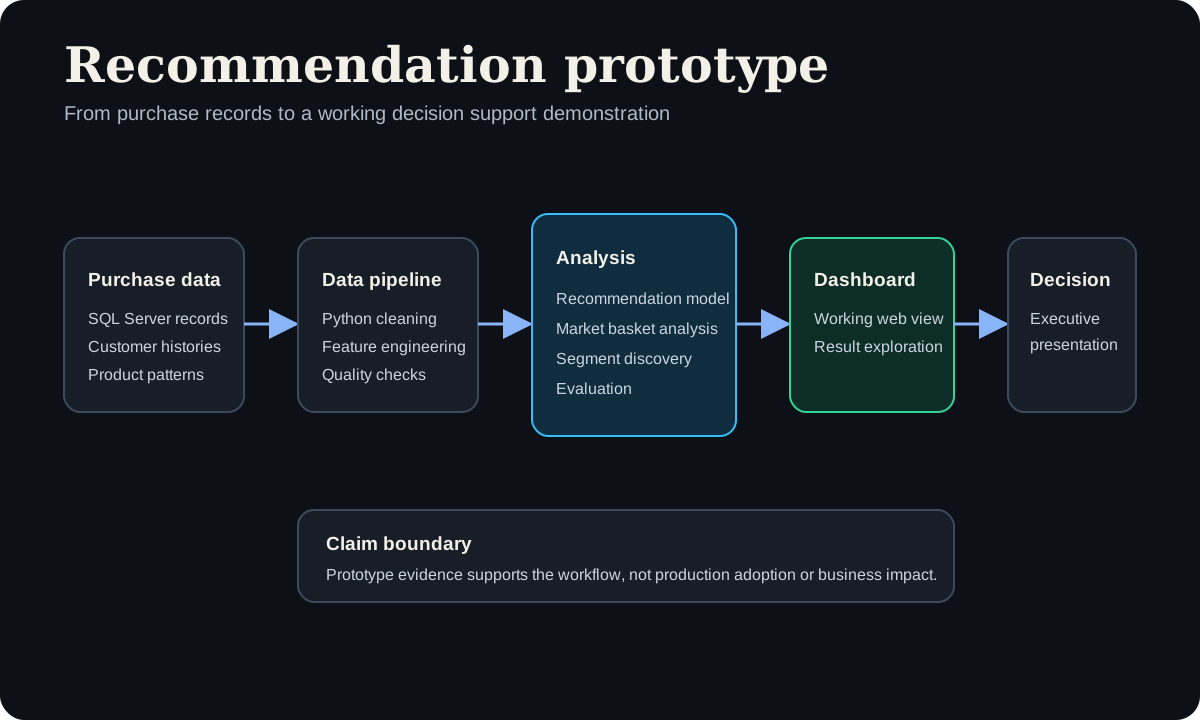
Evidence boundary
Claims and supporting records
During my data analyst internship, I built a prototype pipeline that cleaned and transformed SQL Server purchase records for recommendation and market basket analysis.
Record supporting this claim
I created a working web dashboard for exploring the prototype results.
Record supporting this claim
I presented the completed prototype and its findings to executives while keeping production adoption and business impact outside the claim boundary.
Record supporting this claim
Problem
Historical purchase records can show which products appear together and which recommendations may be relevant, but raw transaction tables are not a decision tool. The internship project needed a repeatable path from stored records to understandable recommendation results.
The deliverable also needed to make the analysis accessible to people who were not working directly in Python or SQL.
Constraints
The work was a time bounded internship prototype built with private company data. Data quality and feature definitions had to be handled before any recommendation could be presented responsibly.
The prototype was not evidence of production adoption or measured business impact. Public documentation cannot expose company records, customer details, internal queries, repository locations, or private presentation material.
Ownership
I built the data pipeline, recommendation analysis, working web dashboard, and final presentation as a data analyst intern. I presented the completed prototype to executives.
I did not own the company data systems or any later product decision. The case study describes the prototype I delivered without claiming that the organization deployed or adopted it.
Decisions
I separated data preparation from recommendation analysis so input quality could be inspected before modeling. SQL retrieved the relevant purchase history. Python handled cleaning, transformation, feature engineering, and analysis.
I combined recommendation work with market basket and segment analysis because each view answers a different question about purchase patterns. A web dashboard made the outputs explorable without requiring a notebook or database connection.
I presented the working prototype and its findings to leadership or executives. No retained presentation artifact supports a more detailed account of the exact presentation content.
Implementation
Purchase records moved from SQL Server into a Python pipeline. The pipeline normalized the source data, constructed analysis features, and applied recommendation, market basket, and segment methods.
The resulting data fed a web dashboard for reviewing recommendations and supporting patterns. The dashboard and analysis then formed the basis of the final executive presentation.
Result
The completed deliverable was a working end to end prototype connecting private purchase data, Python and SQL processing, recommendation analysis, an explorable dashboard, and an executive presentation.
The private candidate record supports completion of that workflow. The public diagram explains the workflow but does not independently prove authorship or delivery. Neither source establishes recommendation accuracy, production use, revenue, conversion, or organizational adoption.
Limitations
The source data, implementation, evaluation artifacts, dashboard, and presentation remain private. The sanitized architecture is the only public evidence attached to this case study.
No model quality number or business result is published because the available public evidence does not support one.
Reflection
A recommendation model is only one part of a useful decision system. Data preparation determines what the model can learn, and the presentation layer determines whether another person can inspect and use the result.
The project taught me to treat the pipeline, analysis, interface, and explanation as one connected deliverable.